17–18 June 2027 | An international conference hosted at St Mary’s University & Strawberry Hill House, Twickenham
In collaboration The Lewis Walpole Library (Yale University) and the Kulturstiftung Dessau-Wörlitz.
The Gothic Revival has long been understood as a predominantly British phenomenon, with Horace Walpole’s Strawberry Hill occupying a central place in its history as a site of aesthetic innovation.
This two-day international conference seeks to broaden and complicate that picture by examining the Gothic Revival as an interdisciplinary and global network of parallel and intersecting manifestations across literature, the visual arts, architecture, and material culture.
Drawing on the methodological framework of histoire croisée (Werner and Zimmermann, 2006) and recent work on the ‘world-gothic’ (Duncan, Cumpsty et al., 2026), it brings together historians of art and architecture, literary scholars, and historians of collecting and antiquarianism to ask how objects, texts, and images moved across geographic and national boundaries in relations of mutual exchange and influence, while tracking how similar aesthetic and cultural impulses emerged across different European, American and colonial contexts.
Strawberry Hill House provides the ideal setting for this enquiry, not merely as an iconic monument of the Revival but as a laboratory in which Walpole and his collaborators experimented with this emergent sensibility.
There his antiquarian and architectural work accompanied his literary endeavours, developing a Gothic mode in which textual and material practices were interconnected, and drawing at once on medieval English sources, continental models, ‘Moorish’ decorative forms and the scholarly networks of a broader multinational conversation about the past.
The Gothic novel emerged in the same way, through reciprocal exchanges across contemporary media, from theatre and music to poetry and painting. If the Revival is a network rather than a lineage, its history is carried by materials as much as by monuments, and translation is not only verbal: Otranto is rendered from an invented Italian original, a Westminster vault into papier mâché in the Gallery at Strawberry Hill. Diverse forms made the Gothic reproducible and portable, and the conference seeks investigate its movement across/through media as well as time and space.
A study tour of the Dessau-Wörlitz Garden Realm will follow on 3-4 September 2027. Its GotischesHaus, which was begun in 1774 and probably uses inspirations from Strawberry Hill for different purposes, is among the earliest Gothic Revival buildings on the Continent and the clearest possible demonstration of the transmissions this conference sets out to trace.
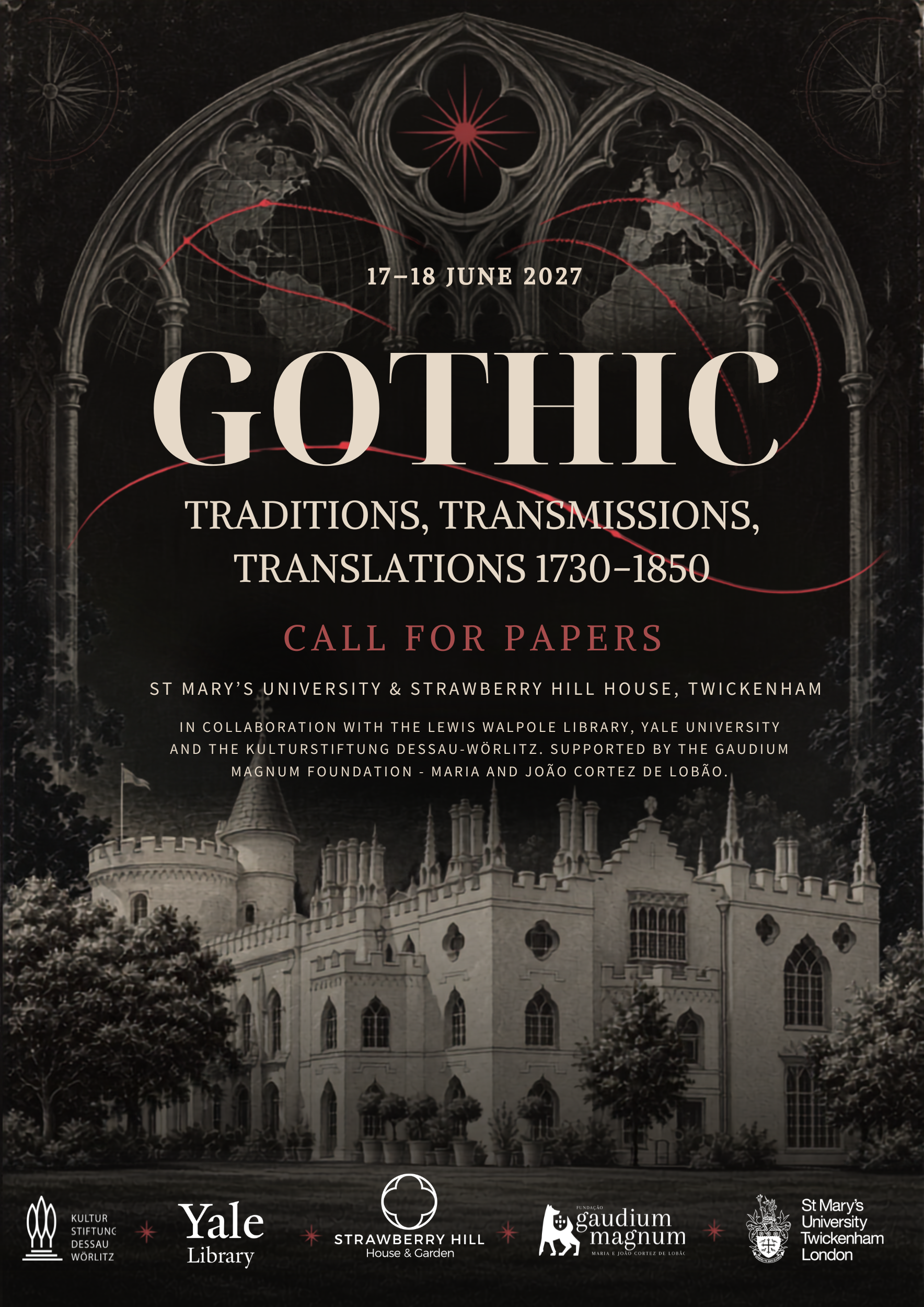
You can download the full Call for Papers as a PDF here. We welcome proposals for twenty-minute papers from scholars at all career stages.
Abstracts of no more than 300 words, accompanied by a brief biographical note of no more than 150 words, should be submitted to gothic2027@gmail.com by 21st December 2026.
For panel proposals, please include an abstract outlining the theme of the panel as well as abstracts for the individual papers. Proposals from early-career researchers and scholars working outside the UK are particularly welcome.
Supported by the Gaudium Magnum Foundation – Maria and João Cortez de Lobão.